CIDO Day in the Life
I recently accepted the role of Senior Vice President, Chief Information Digital Officer (CIDO), leading the organisation Enterprise Technology and Insights, which covers Information Technology, Data & Analytics and Information Security.
The organisation commands a budget of approximately $255M with 400+ full time employees (alongside contractors, managed service providers, etc.)
I have held the role in an interim capacity since December, having previously served as Chief Technology Officer (CTO) and Chief Information Security Officer (CISO).
As CTO, I shared a day in the life, which outlined my approximate routine (recognising that it changes week from week).
Interestingly, as I reflect upon this article, the fundamentals remain consistent.
My morning and evening rhythm is mostly unchanged, as I still prepare and take my children to school, etc.
My nutrition and fitness are also stable. However, I now commonly work from the office three days per week, with more frequent travel (which requires personal flexibility and additional support from my wife).
What has evolved is my working day. Therefore, I thought I would share a snapshot of how I allocate my time. This is obviously an approximation, which changes per month depending on the business priorities, etc.
The Working Day
My working day is usually back-to-back, with a combination of meetings and focused time.
As I have progressed in my career, the balance has shifted from individual contributor activities, towards meetings.
My team are predominately based in the UK, US, India and Poland. As a result, I commonly connect with the India/Poland/UK team in the morning, with the afternoon dominated by the US.
The global nature of the team can make time zone alignment a challenge (+5:30 to -5:00). Therefore, I accept the traditional 9-to-5 hours are not viable, instead I structure my week knowing that the start and finish times will vary.
I do however attempt to protect evening dinner with my family and exercise (ideally during the day, providing a welcome break from the desk).
To help provide insights into the structure of my day, I have analysed my schedule over one month. The approximate results can be found below, highlighting where I spend my time.
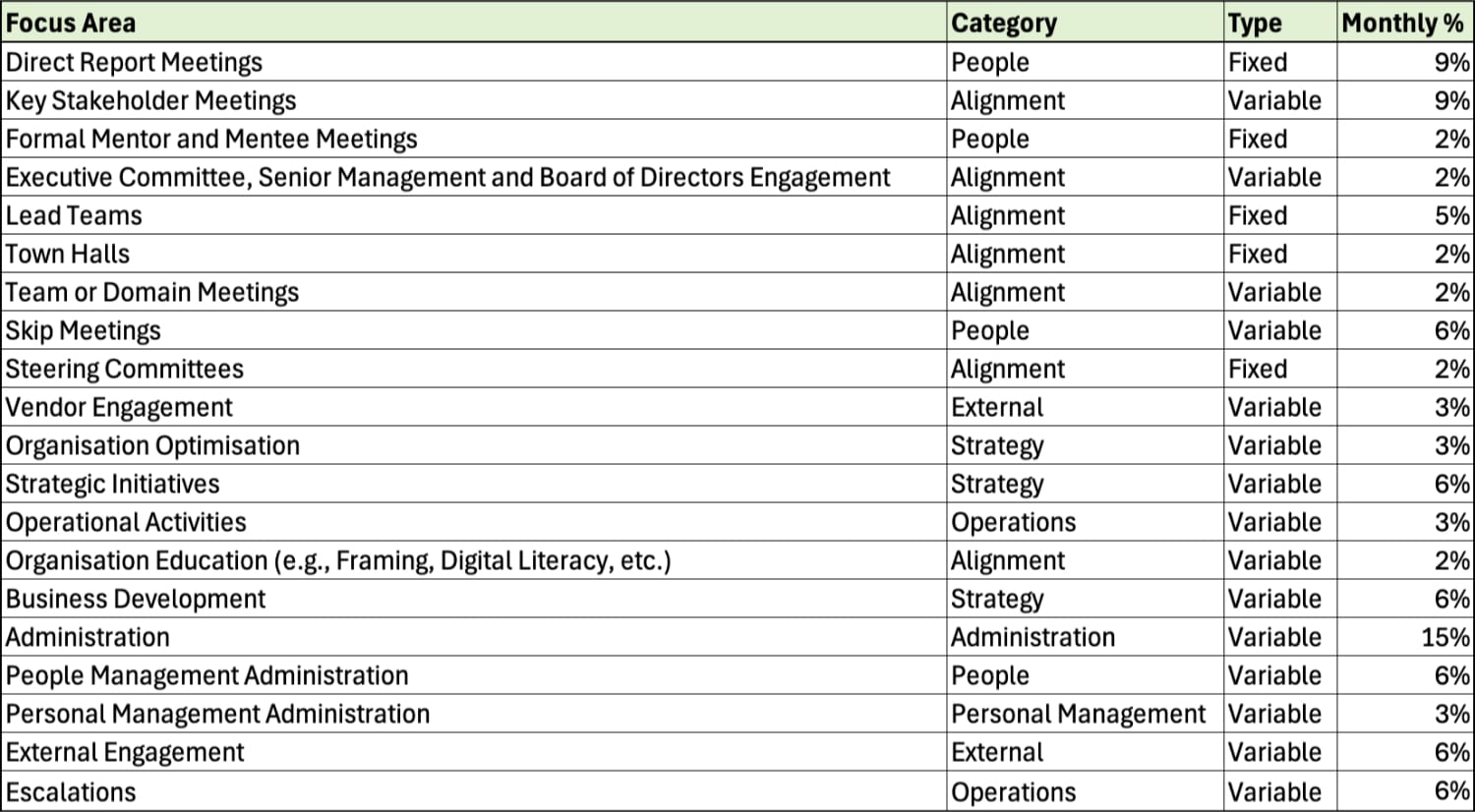
My company and industry are very relationship-based, therefore I do have a lot of meetings, up to 8 per day, 160 per month (many of which are 30mins in length).
Knowing this dataset is an average, captured over a single month, I acknowledge the balance of these categories and percentage time consumed varies, influenced by many variables.
Looking at the data in more detail, my top five categories are:
- People (Direct Reports, Skip Meetings, People Development, etc.) = 23%
- Alignment (Town Halls, Team Meetings, Steering, Partners, etc.) = 23%
- Strategy (Organisation, Initiatives, Business Development, etc.) = 15%
- Administration (Email, Approvals, Content Review, Content Creation, etc.) = 15%
- Operations (Reviews, Escalations, etc.) = 9%
Unsurprisingly, most of my time (approximately 23%) is spent with the people, interacting with individuals in different roles.
In my opinion, as CIDO, I work for the team. My job is to ensure every individual has the foundation to succeed, providing them empowerment and autonomy to do their best work, focused on an outcome with clear value that motivates and hopefully provides personal fulfilment.
Another key role is alignment, ensuring the organisation has a clear vision, mission and strategy, supported by priorities that are measurable to ensure focus and promote discipline. Alignment must occur at all levels and requires continues engagement via multiple channels. For example, I publish a minimum of two internal blog posts per month, alongside regular meetings.
Finally, I would highlight strategy. A core part of my role is to help the business unlock new opportunities through the transformative power of technology and data, including emerging trends such as Artificial Intelligence, etc. This requires me to construct and deliver a compelling narrative, which educates and influences the business direction, looking to ensure we continuously challenge preconceptions and ambitiously embrace innovation.
The biggest area of opportunity for personal optimisation is the time spent on administration activities, hopefully simplifying processes or leveraging automation to reduce the time spent completing bureaucratic tasks that can distract from the primary outcome.
Conclusion
This structure represents a fairly accurate view of my working time, with weekends dedicated to chores, family and friends.
My wife and I do not have family that live close, therefore with two demanding jobs and two young kids, the working week is intense. However, thanks to a supportive wife, happy kids and great friends, I continue feel incredibly fortunate and thankful.