NVIDIA DGX Spark
After a five-month delay, NVIDIA has finally released the DGX Spark, the self-described “Grace Blackwell AI supercomputer on your desk”.
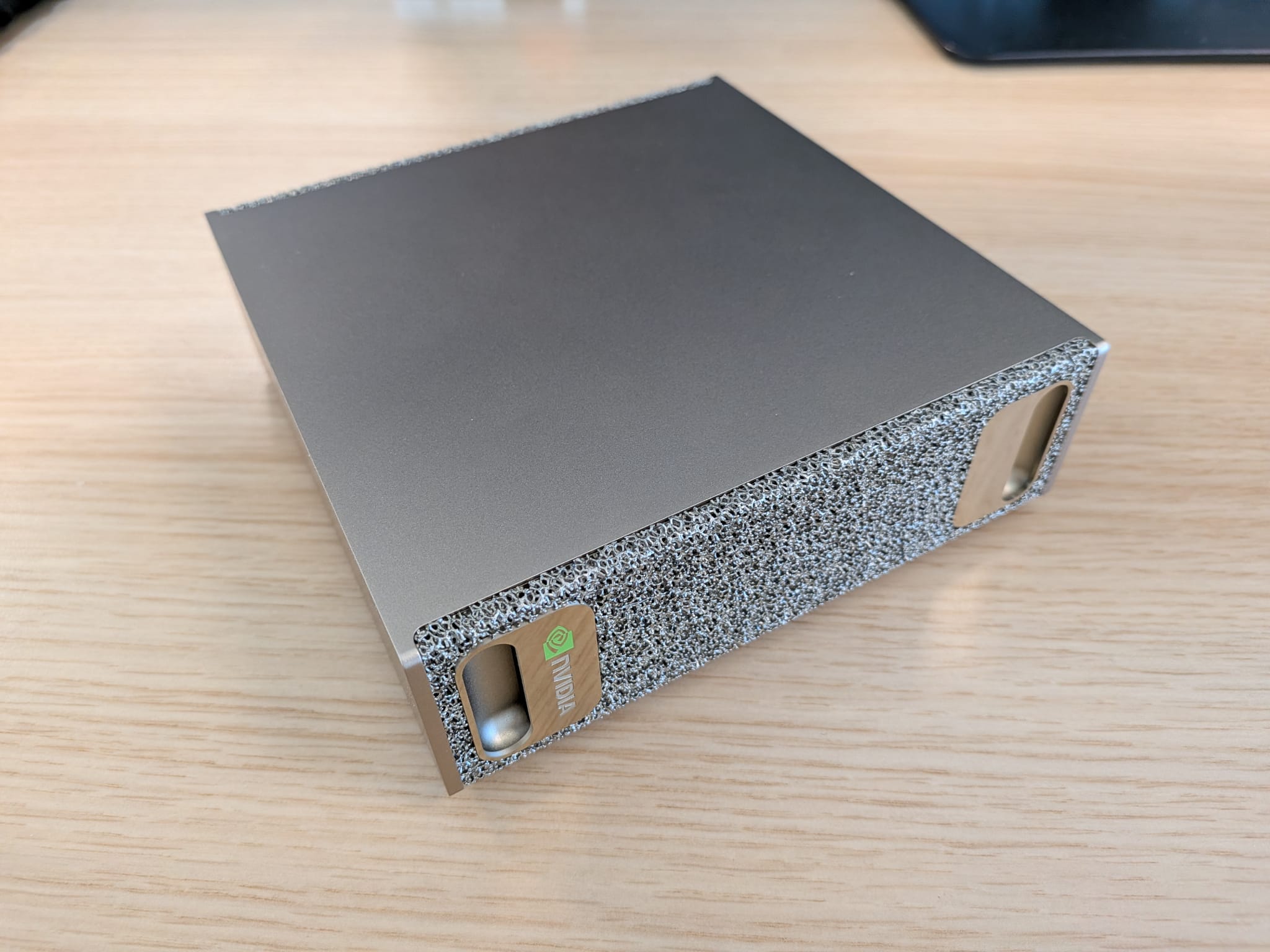
The specification of the NVIDIA DGX Spark is listed below.
CPU: Arm 20 Core (10 Cortex-X925 + 10 Cortex-A725)
GPU: Blackwell Architecture
CUDA Cores: 6,144 (Blackwell Generation)
Tensor Cores: 5th Generation
RT Cores: 4th Generation
System Memory: 128GB LPDDR5X 8533 16 channels (256 bit)
Storage: 4TB M.2 NVM-e SSD
Network: 2x 100GB/s ConnectX-7 NIC, 1x 10GB/s Ethernet, Wi-Fi 7, Bluetooth 5.4
Display Connectors: 1x HDMI 2.1a
Connectivity: 4x USB-C
The standout components include the 128GB unified memory, delivering 273GB/s bandwidth, the GB10 Blackwell GPU, which provides up to 1 petaFLOP of AI performance at FP4 precision, as well as the dual 100Gb/s ConnectX-7 network interface cards, enabling high-performance distributed computing.
In addition, the NVIDIA DGX Spark supports the NVFP4 precision format, a novel 4-bit floating-point representation developed specifically for NVIDIA’s next-generation inference pipeline.
In theory, a single NVIDIA DGX Spark is capable of running a 200 billion parameter AI model locally. With two connected via NVIDIA ConnectX Networking, AI models of up to 405 billion parameters become feasible.
The NVIDIA DGX Spark is £3,699.98, making it an expensive proposition. By comparision, the Minisforum MS-S1 MAX, equipped with AMD Ryzen AI Max+ 395 and 128GB LPDDR5x is £2,079.00. You can also purchase an NVIDIA GeForce RTX 5090 for £1,799.
The AMD Ryzen AI Max+ 395 has the same unified memory architecture, with a memory bandwidth of 256GB/s (just below the NVIDIA DGX Spark of 273GB/s).
As a result, for basic AI inference (using AI models via Ollama and/or LM Studio), any system equipped with the AMD Ryzen AI Max+ 395 will perform similarly to the NVIDIA DGX Spark. These systems, which are x86-64, will also be more versatile, as they can run Windows and Linux software with no constraints.
The NVIDIA GeForce RTX 5090 has a memory bandwidth of 1,792GB/s, which is far beyond the NVIDIA DGX Spark and AMD Ryzen AI Max+ 395.
As a result, the NVIDIA GeForce RTX 5090 will easily outperform the NVIDIA DGX Spark for AI inference, whilst also delivering market-leading gaming performance. However, with only 32GB of VRAM, the size of the AI models will be restricted.
Therefore, depending on your use case, the NVIDIA DGX Spark may not offer much unique value. In fact, it may be less performant and versatile, whilst being more expensive.
With this in mind, the only people who should consider an NVIDIA DGX Spark are those who are interested in AI development, using the NVIDIA AI hardware/software ecosystem.
With this audience in mind, the NVIDIA DGX Spark provides a compelling entry point to prototype, fine-tune, and deploy large AI models on a desktop computer, using tools and techniques that translate directly to enterprise NVIDIA products and services.
Over the coming weeks, I will be testing the NVIDIA DGX Spark, targeting a range of AI development workloads.
Stay tuned for updates.